Tampilkan postingan dengan label historical. Tampilkan semua postingan

Jumat, 13 Maret 2015

the Campbell Chariot of the Henry Ford museum, built in 1797 by New York coachmaker William Ross


Found on http://www.brhoward.com/ross_chariot.html

One of only two known vehicles of its type, is a rare survivor among only a handful of 18th century American carriages and perhaps the only vehicle that remains in original condition.

Kamis, 12 Maret 2015

one of two known 1926 Model TT Ford Motor Home


Ford Motor Co. records indicate that only six modified chassis, such as the one used to construct this motor home, were ever built.

The framing of the superstructure was made from new Model T Ford automobile frame rails, bolted and riveted together. The rear porch pillars were driveshaft tubes from one-ton Model TT Ford trucks.

The modification of the chassis included but was not limited to a second independent non-powered axle used to create tandem rear wheels and an overall extension of the chassis by more than eight feet. The body of the motor home is thought to be a third party addition to the chassis and was not constructed by Ford.

Rhene Miller grew up on a dairy farm in Pennsylvania and made her first public appearance at the age of three when she was featured in her father's traveling medicine show. She studied music in New York City and became a "one-girl band" with the Barnum and Bailey Circus. Her life story is interesting and in a book you can read on Google

 During the Great Depression, her circus closed and she and her husband, Charles Meyer, drove their circus carriage into Smackover in 1929. This 1926-27 Ford T-Model vehicle, the forerunner of the modern-day motor home, served as living quarters to Rhene for the next fifty-five years.

In the late 1990's the motor home was removed from its swampy parking space and placed on exhibit at the Arkansas Museum of Natural Resources in Smackover.

Found on http://www.brhoward.com/model_t_motor_home.html  with more images and info from
http://www.amnr.org/goat.htm , https://www.flickr.com/photos/jannikonmcneil/4833845324/in/photostream/  , http://www.arkansas.com/cities/smackover , http://kbeau.blogspot.com/2009/04/goat-lady.html

Selasa, 10 Maret 2015

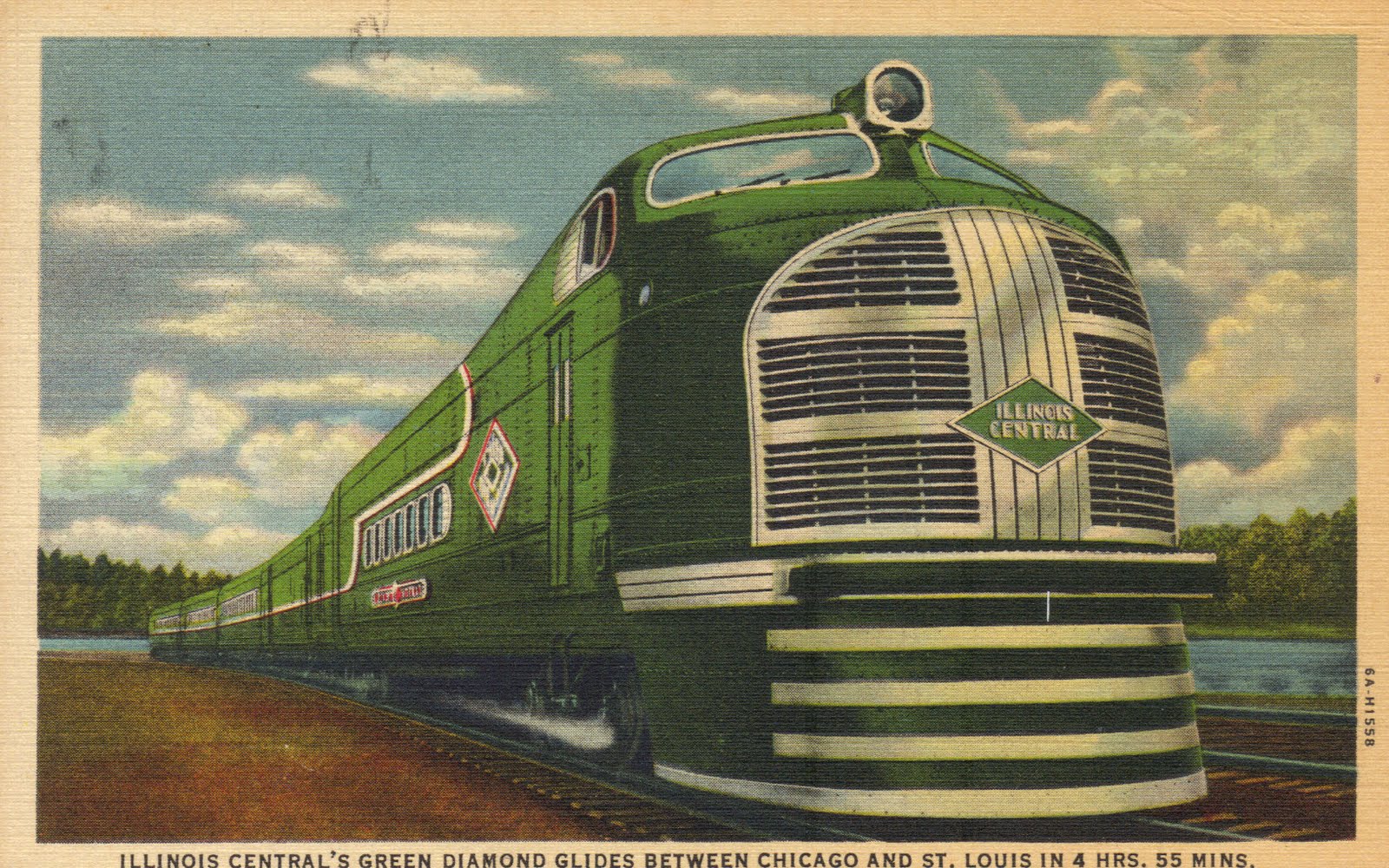
Illinois Central Green Diamond streamliner,


The Illinois Central's first streamlined passenger train proved popular with the traveling public between Chicago, and St. Louis on the Illinois Central Railroad. It operated from 1936 until 1968.

The name honored the "green diamond" in the Illinois Central's logo as well as the Diamond Special, the Illinois Central's oldest train on the Chicago-St. Louis run.

Like the second-generation City trains which it resembles, the Green Diamond was built by Pullman, but was made of Corten steel rather than aluminum. Pullman constructed the Green Diamond's original fixed consist, which included a power car, baggage/mail car, coach, coach-dinette, and kitchen-dinette-parlor-observation car. The coach seated 56, while the coach-dinette seated 44 in the coach section and the dinette area had seating for 16. The parlor car had seating for 22.

 It was the last fixed-consist train built in the 1930s for a railroad in the United States. The train's interior was art deco, as was popular in the period.

Found on https://www.facebook.com/HeritageRailway?fref=photo

http://www.rediff.com/money/slide-show/slide-show-1-historic-and-iconic-images-of-train-journey/20120830.htm#28


Found on http://streamlinermemories.info/?p=2351

http://streamlinermemories.info/Eastern/GreenDiamond.jpg

Senin, 09 Maret 2015

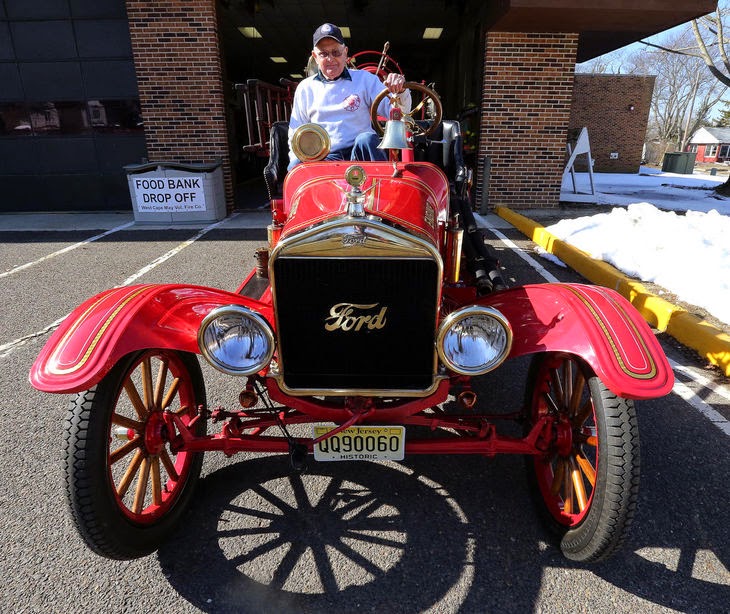
Imagine getting the chance to buy your great-grand dads fire truck, the one he was the Fire Chief on


photos from a gallery of a couple dozen images you might want to see at http://www.pressofatlanticcity.com/gallery/news/ford-model-t-fire-pumper/collection_867d52dc-c454-11e4-8033-c754830d5e0f.html?mode=jqm&pos=8

There is a video on http://videos.pressofatlanticcity.com/1921-Model-T-Fire-Truck-Back-in-West-Cape-May-28675714

Back in 1921 Chuck McPherson�s great-grandfather, Bill Eldredge was the fire chief of the West Cape May Volunteer Fire Company, and spearheaded the effort to get a Model T pumper fire truck, Ford made the cab and chassis, but then the company had to bring the chassis to the Hale Fire Pump Co. in Conshohocken, Pennsylvania, for installation of the pump and other outfitting work.

Recently, a fire truck collector called Chuck and offered him first chance to buy it. Chuck is the possibly 4th generation fire fighter, his great grand dad was fire chief in 1921, his grand father joined the fire dept in 1937.

While modern pumpers carry at least 1,000 gallons of water, the Model T has a 60-gallon tank. It could be set to draft from a lake or other water source, while another option was using a bucket brigade to keep filling the tank through a �slop feed� on the top.

If they had to go in a house, a handy Dietz kerosene lantern hung on back of the truck for interior lighting.

For more of the story: http://www.pressofatlanticcity.com/news/west-cape-fire-department-gets-model-t-pumper-back/article_3050c0b4-c603-11e4-abea-8f4757f5eb4b.html

Model T hearses

Jumat, 06 Maret 2015

Oldest operating steam locomotive, the Fairy Queen, 1855


photo from https://www.flickr.com/photos/ramesh_lalwani/4999023196/

Running between the Indian capital of New Delhi and Alwar, in Rajasthan. It was certified by the Guinness Book of Records in 1998 as being the world's oldest one in regular operation after being restored to haul a luxury train in order to boost tourism in Rajasthan.  http://en.wikipedia.org/wiki/Fairy_Queen_%28locomotive%29

Kamis, 05 Maret 2015

It was April 1917 and Goodyear set out to create trucking as we know it. From coast to coast on pnuematic tires, in days not weeks.


The first truckers? Harry Smeltzer and Harry Apple, the pioneers of interstate trucking, and their rig? A 5 ton Packard. 
Above photo and below video courtesy of Mike and Goodyear! Thanks!


image from http://www.lincoln-highway-museum.org/NPS/03-NPS-Index.html


Image found on The Old Motor http://theoldmotor.com/?p=56024 which is most likely one of the two escort vehicles, which carried supplies. This photo didn't come with info... so it's anyone's guess as to what it was used for


above two images from http://www.camionactualidad.es/noticias-marcas-fabricantes-camiones/vehiculos-historicos-y-clasicos/item/912-goodyear-wingfoot-express.html

The truck made the 740-mile trip from Akron to New England in 28 days, 21 days late and having went through 28 tires. The two-man team and their film crew made it to Goodyear's fabric mill in Killingly, CT, where much to their surprise they were greeted by Mission of Burma a brass band and hundreds of cheerful mill workers.

It's not a reflection on tire quality to mention how many went flat, you have to keep in mind that the amount of horses who'd lost horseshoe nails for the previous hundred years and the terrible conditions of 700 miles of unpaved, non improved roads.

The truck was a five-ton Packard, but the 10-foot-high, specially built body had been designed by Goodyear. Behind the novel traveling bunk, the cargo bed was loaded with a dozen spare tires, a compressor to inflate them, 500 feet of manila line, shovels and a heavy block and tackle.

What was most novel about Goodyear's truck, named the Wingfoot Express, was the big pneumatic tires it rolled on. Hard, solid rubber tires were standard equipment for short hauls in those days.

two escort vehicles were along, sent for safety's sake, carrying in addition to the usual tools...  60 liters of oil, 40 liters of petrol and 60 liters of water. Also, carrying what the convoy needed most, an air compressor to pump up all the replacement tires.

The three-vehicle caravan that set out to do just that was barely to the Akron outskirts when it became mired in the mud. So began an agonizing odyssey of muddy ditches, broken bridges, blown out tires and engine failures.

It came as no surprise that a heavy truck would have much more difficulty on the poorly graded dirt roads than the farmers' lightweight buggy. Bridges that safely carried farm wagons collapsed under the Packard truck. Twice the engine failed and had to be rebuilt.

The support cars were worn out by the time the caravan reached Pittsburgh and were traded for new ones. Blowouts occurred about every 75 miles as the truck plodded ahead at 15 mph.

As Smeltzer described the trip, "It took 28 days and 28 tires." The trip back with fabric from the mill was less eventful and took just five days.

 Walter Shively, the tire engineer, promptly applied the lessons learned in the grueling truck tire test and improved tires were almost immediately available. A stronger bead and heavier sidewalls produced a tire more resistant to blowout.

Future trips employed seven Wingfoot Express trucks, ranging from three- to five-ton models of White, Mack and Packard. The 740-mile run one way was pared down to 80 hours running time within a year.

They carried tires to Goodyear dealers in the Boston area, or shoe soles for New England footwear makers, bringing back tire fabrics from the Connecticut mill.

The success of the Wingfoot Express was reflected by a spurt in highway construction, as state governments strived to improve roads within their jurisdiction. The Lincoln Highway movement, conceived in 1913 to create a modern coast-to-coast highway, was strongly supported by Goodyear's President Frank Seiberling.

by 1919 they were coast to coast

Info from http://www.goodyear.com/corporate/history/history_wingfootexpress.html


In 1918, the same trucks that had conquered the ten-foot snow drifts of Pennsylvania's worst winter in decades, left Boston for San Francisco. This time, the caravan faced a round trip of 7,763 miles, some of it across trackless desert. In Wyoming alone, 36 of 56 wooden bridges gave way beneath the highway giants.

This time the commercial cargo was aviation tires needed by the Army on the West Coast. Again, the persistent Goodyear teams overcame all obstacles of road conditions and weather. After completing four round trips totaling 30,000 miles, the Express trucks had established a new world transcontinental record, coast-to-coast in just 14 days.


Found on http://forums.justoldtrucks.com/25451/cooperation-sleeper-cab?PageIndex=16  and http://www.goodyear.com/corporate/history/history_wingfootexpress.html

image from http://www.cheersandgears.com/topic/78687-gmc-art/

By the 1920's it was decided that another pair of tires would be an engineering necessity to lessen the load and increase the life expectancy of any tire, through the lower load on each, and they added a 2nd axle in the rear


Photo from http://www.camionactualidad.es/noticias-marcas-fabricantes-camiones/vehiculos-historicos-y-clasicos/item/912-goodyear-wingfoot-express.html


photo from http://www.cheersandgears.com/topic/78687-gmc-art/

Not until 1926 was the production of pneumatic tires higher than that of solid tires; four years later the ratio was 10-1 and ten years later by 10,000 to one.

some info from http://www.urlaubsspass.de/auto/160507-wingfoot/160507-wingfoot.htm


the above 8 wheel bus was used to pick up and return Goodyear employees from the company housing development in Goodyear Heights to the Akron tire factories for 2 cents a trip. Firestone did the same thing.


above 3 images from http://www.cheersandgears.com/topic/78687-gmc-art/ and are 1921

the left most tandem axle truck is described in Electric Traction Vol 16


So these ads seem to indicate that Goodyear was selling prefab homes in the 40's during WW2 (notice the "Buy War Bonds") , and using the name Wingfoot Homes and the material that insulated the homes was the "Pliofoam" used to seal war aircraft gas tanks from bullet holes.


and in the 1980s they did an homage to the 1917 Ohio to Connecticut run on the sides of their trucking trailers.

Images from Ebay listings


found on http://www.oldcaradvertising.com/Packard%20Ads/1922/1922%20Packard%20Truck%20Ad-01.html

Selasa, 03 Maret 2015

A proud looking group with a chassis of an Opel


The guy in the center is holding a crank shaft.

From the words on the wall and on the chassis, this was a school piece for mechanics to learn about the mechanical parts, without all the body and interior being a constant delay in getting to the transmission and rear axle

Found on https://www.facebook.com/isabelle.bracquemond.7?fref=nf of course!

Sabtu, 28 Februari 2015

fire stations still had steam pumpers hanging out in back, though they had new fire engines


Found on http://www.shorpy.com/node/18056?size=_original#caption

often on Shorpy the commentors are very highly focused on the details and point out some cool things you might not notice... in this photo, they noticed that the steam pumper is facing the back of the room, probably because it's retired, and that the fire truck is a Seagrave from about 1916, and look at the really bad tire rubber on the left front.

the 1933 August storm flood took out the center bridge support, and the photographer took a photo from both ends of the track near Kenilworth


The Crescent Limited operated from New York to Washington on the Pennsylvania Railroad, on the Southern Railway from Washington to Atlanta


Details and photos on http://www.shorpy.com/node/18074?size=_original#caption  and  http://www.shorpy.com/node/18075?size=_original#caption